
What is the method?
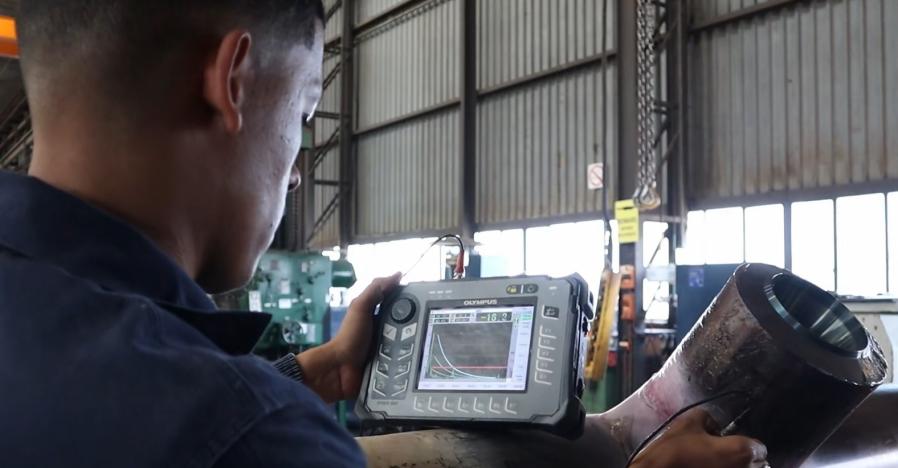
Ultrasonic Testing (UT) uses high-frequency sound waves introduced into the material to detect internal discontinuities or measure thickness. Reflected signals are analysed to determine flaw location, depth, and wall thickness.
Application
Ultrasonic Testing (UT) uses high-frequency sound waves introduced into the material to detect internal discontinuities or measure thickness. Reflected signals are analysed to determine flaw location, depth, and wall thickness.
Key Benefits
- Detects internal discontinuities without radiation.
- Provides immediate on-site results.
- Highly effective for thickness measurement and corrosion monitoring.
- Portable and widely applicable in the field.
Inspection Capabilities
- One of the most versatile methods for both flaw detection and thickness measurement.
- Allows inspection and thickness measurement from one side only.
- Particularly useful for in-service inspections requiring rapid direct evaluation.
- Can be adapted with different probes and wave modes for many materials and geometries.
Limitations
- Requires surface contact and couplant.
- Performance depends on calibration and operator skill.
- Rough surfaces and coarse-grain materials can affect results.
- Discontinuity orientation influences detectability.