





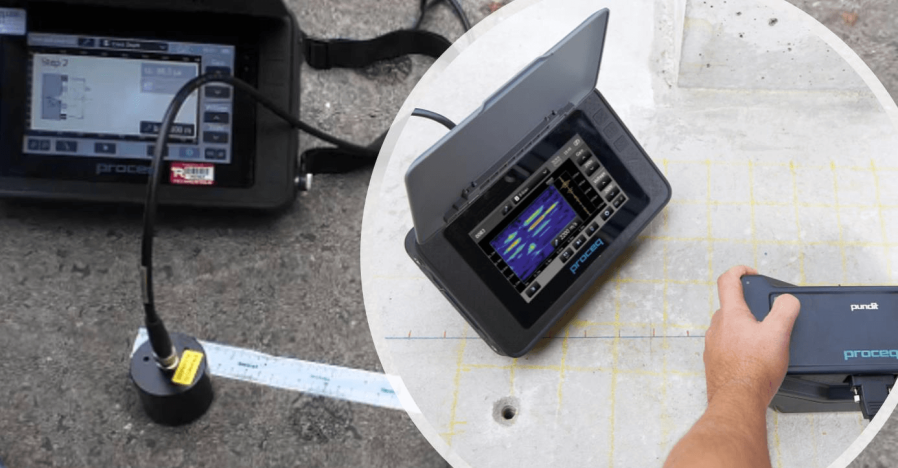
What is the method?
Ultrasonic testing of concrete uses low-frequency sound transmission to assess the internal condition, continuity, and relative quality of concrete structures.
Application
Ultrasonic testing of concrete uses low-frequency sound transmission to assess the internal condition, continuity, and relative quality of concrete structures.
Key Benefits
- Non-destructive evaluation of concrete integrity.
- Helps identify hidden defects without unnecessary demolition.
- Supports structural condition assessments.
- Useful for rehabilitation and life-extension projects.
Inspection Capabilities
- Provides insight into voids, cracking, delamination, segregation, and relative concrete quality.
- Useful for large structural members where destructive sampling is undesirable.
- Can assist with assessment of service deterioration, fire damage, or poor consolidation.
- Supports targeted engineering intervention planning.
Limitations
- Concrete variability affects interpretation.
- Reinforcement, moisture, and aggregate content influence results.
- Often requires correlation with other structural assessment methods.
- Best used as part of a broader structural evaluation programme.