What is the method?
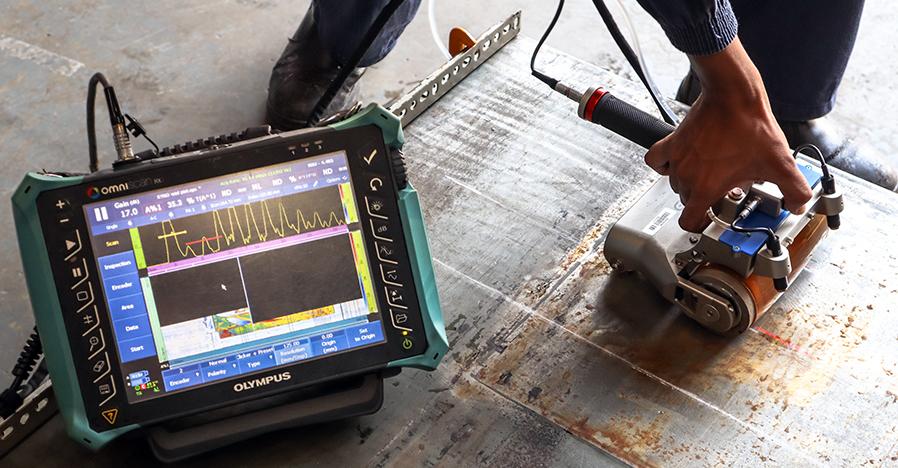
Manual Ultrasonic Corrosion Mapping (MUT) using handheld encoded scanners such as wheel probes is a portable ultrasonic technique that generates C-scan corrosion maps while the operator manually scans the inspection surface.
Application
Manual Ultrasonic Corrosion Mapping (MUT) using handheld encoded scanners such as wheel probes is a portable ultrasonic technique that generates C-scan corrosion maps while the operator manually scans the inspection surface.
Key Benefits
- Portable and practical for field-based corrosion mapping.
- Greater coverage than manual spot UT.
- Useful for targeted follow-up and anomaly sizing.
- Produces visual corrosion maps without large mechanised systems.
Inspection Capabilities
- Bridges the gap between spot thickness readings and full automated mapping.
- Particularly useful for localised corrosion, repair assessments, and short-section wall-loss profiling.
- Wheel-probe and handheld encoded systems allow rapid on-site C-scan generation where large scanners are impractical.
- Ideal for targeted field deployment with improved visualisation of corrosion extent and shape.
Limitations
- Dependent on operator technique, tracking accuracy, and coupling consistency.
- Surface roughness, coatings, and access can affect data quality.
- Better suited to targeted mapping than large-area scanning.
- Requires competent interpretation to distinguish real indications from artefacts.