
What is the method?
Tube Inspection comprises a range of advanced NDT methods used to assess the condition of heat exchanger tubes, condenser tubes, boiler tubes, fin-fan tubes, and other tubular components. These techniques are selected according to the tube material, expected degradation mechanism, inspection objective, and outage requirements. The primary techniques include ECT for non-ferromagnetic conductive tubing, IRIS for accurate 360-degree wall-thickness measurement, RFT for ferromagnetic tubing, Magnetic Bias (MB) to improve electromagnetic inspection of ferromagnetic tubing, and Eddy Current Array (ECA) for enhanced circumferential coverage, improved data resolution, and faster scanning.
Application
Tube Inspection comprises a range of advanced NDT methods used to assess the condition of heat exchanger tubes, condenser tubes, boiler tubes, fin-fan tubes, and other tubular components. These techniques are selected according to the tube material, expected degradation mechanism, inspection objective, and outage requirements. The primary techniques include ECT for non-ferromagnetic conductive tubing, IRIS for accurate 360-degree wall-thickness measurement, RFT for ferromagnetic tubing, Magnetic Bias (MB) to improve electromagnetic inspection of ferromagnetic tubing, and Eddy Current Array (ECA) for enhanced circumferential coverage, improved data resolution, and faster scanning.
Key Benefits
- Provides a comprehensive inspection solution across varying tube materials and damage mechanisms.
- Enables the most suitable technique to be matched to the tube metallurgy and expected defect type.
- Supports accurate decisions on tube plugging, retubing, repair scope, and remaining life.
- Helps avoid unnecessary equipment replacement.
- Improves reliability and availability of critical heat transfer equipment.
- Combines rapid screening methods with accurate sizing techniques.
- Supports trending against historical data and outage planning.
Inspection Capabilities
- ECT enables fast screening of large populations of non-ferromagnetic tubes, ideal for outage decision-making and condition ranking.
- IRIS delivers accurate 360-degree quantitative wall-thickness measurement, allowing distinction between internal and external wall loss.
- RFT is especially effective on ferromagnetic tubes, where conventional ECT is limited, and can identify internal and external defects through the full wall thickness.
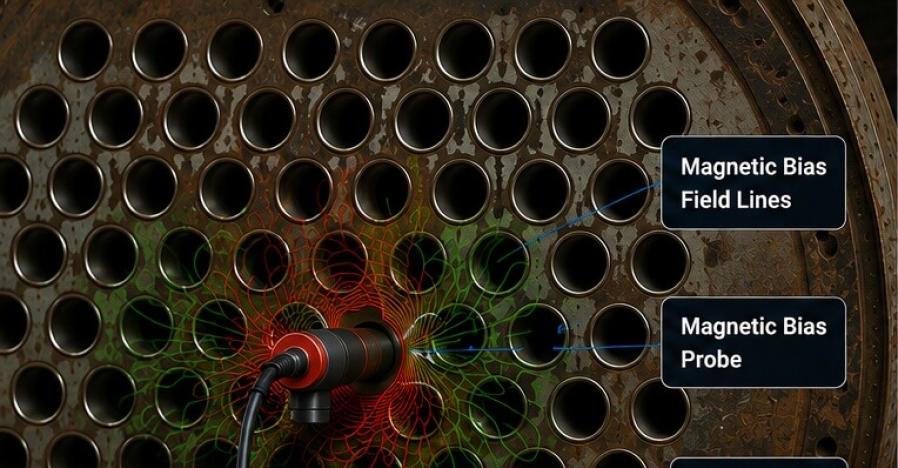
- Magnetic Bias (MB) enhances inspection sensitivity in ferromagnetic tubing, improving capability where standard electromagnetic techniques are restricted by magnetic material effects.
- ECA provides enhanced circumferential coverage, faster scanning, improved defect resolution, and advanced data imaging, making it highly effective for complex degradation and high-productivity tube programmes.
- Together, these methods allow the inspection programme to address mixed tube materials, multiple damage mechanisms, and both screening and quantitative evaluation requirements.
Limitations
- Technique selection depends on tube material, wall thickness, diameter, cleanliness, access, and expected degradation mechanism.
- ECT has limitations on some ferromagnetic materials unless specialised techniques are used.
- IRIS requires tubes to be clean and water-filled.
- RFT, MB, and ECA require appropriate equipment, procedure selection, and experienced analysts.
- Deposits, fouling, support interference, geometry changes, and probe centring can influence data quality.
- Some methods are best for screening, while others are intended for accurate sizing, so a combined approach is often required.